In previous posts, I’ve explored the concepts of food self-sufficiency and food self-reliance, tracing their roots in development thinking and their re-emergence in today’s food policy landscape. Much of that discussion has focused on countries where import dependence is stark. But what about Canada? In this post, I explore data on food self-sufficiency in Canada.
At first glance, Canada appears largely self-sufficient in food production. As one of the world’s largest agricultural exporters, the country is often framed as a global breadbasket, producing far more food than it consumes. Yet this framing obscures a more complex reality: Canada’s strength in export-oriented agriculture does not necessarily translate into self-sufficiency across the foods that we actually eat.
A Closer Look at What Canada Produces
Canada’s agricultural system is highly specialized and deeply integrated into global markets. We are a major exporter of grains, oilseeds, and animal proteins. However, when it comes to foods that are essential to healthy diets, particularly fresh fruits and vegetables, the picture is mixed.
Recent analysis by Farm Credit Canada highlights that the proportion of food consumed domestically that is produced within Canada has declined over time from roughly 80% at the beginning of the 2000s to approximately 70% today. While Canada produces a significant share of its fresh fruits and vegetables, and investments in controlled environment agriculture and domestic horticulture have improved production in recent years, domestic production meets only a portion of national demand, and the country remains heavily reliant on imports for fresh produce. Figure 1 below which fresh fruits and vegetables we import more than we export, then those which we export more than we import. For fruits in particular, domestic production accounts for a relatively small share of consumption, with American and Mexican imports filling the gap. FCC also notes that Canada depends on the United States for roughly 40% of fruit and vegetable imports.
Figure 1: Canada’s Net Imports and Net Exports of Fresh Fruits and Vegetables
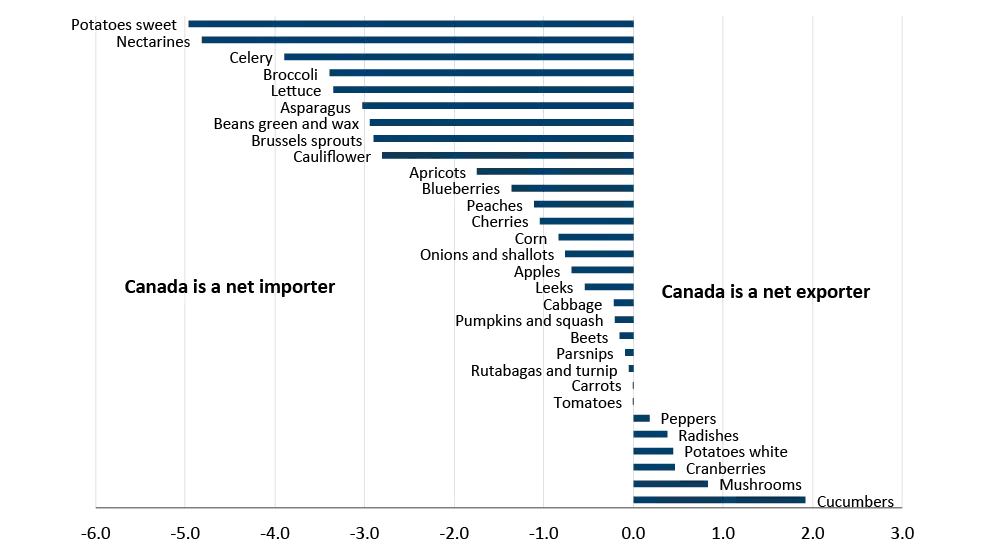
Source: Farm Credit Canada
This reliance is not incidental. Canada’s climate places natural constraints on year-round production, particularly for fruits and certain vegetables. At the same time, decades of policy and market incentives have favoured export-oriented commodity production over diversification into horticulture and other labour-intensive sectors. The result is a food system that is globally competitive, yet lacking alignment with domestic consumption. In a highly globalized world, this makes sense. But increasingly uncertain global food supply chains raise questions about Canada’s efforts to feed its citizens.
Self-Sufficiency in a Canadian Context
Viewed through the lens of food self-sufficiency, Canada presents an interesting paradox. The country is highly self-sufficient in some categories, while remaining structurally dependent on imports in others. This reinforces a key point from earlier posts: food self-sufficiency is not a binary condition. It is better understood as a set of sector-specific capacities, shaped by geography, economics, and policy choices. In Canada’s case, self-sufficiency is strong where production systems are capital-intensive, export-oriented, and well-supported by infrastructure. It is weaker where production is seasonal, labour-intensive, or less integrated into global commodity chains.
A lens of food self-reliance, as I’ve outlined in previous posts, can add another layer to this analysis. Beyond production volumes, it raises questions about domestic capacity: the ability to grow, distribute, and access food within the country, particularly under conditions of disruption. In Canada, this includes not only primary production, but also processing, storage, transportation, and retail systems, many of which have come under strain in recent years.
Canada’s reliance on imported fruits and vegetables has long been understood and, in many ways, accepted. Imports provide dietary diversity, year-round availability, and access to foods that cannot be produced domestically at scale. But this reliance is increasingly being reconsidered in light of growing uncertainties. Climate change is affecting production in key exporting regions. Supply chains are becoming more vulnerable to disruption, whether from extreme weather, geopolitical tensions, or logistical bottlenecks. These dynamics are not hypothetical; they have already begun to shape food availability and prices in Canada.
In this context, food self-sufficiency, particularly in sectors like fresh produce, takes on renewed importance. Not as a call for autarky, but as a question of resilience: how much domestic capacity is enough to buffer against external shocks?
The challenge for Canada is not to become fully self-sufficient across all food categories. That is neither feasible nor desirable. Canadians benefit from global trade, and foods like citrus, coffee, French wine and avocados, will always be part of the national diet. At the same time, the current balance raises important policy questions. Should Canada maintain or expand its capacity to produce certain foods domestically, even if imports remain cheaper or more convenient? What role should public policy play in supporting sectors that contribute to resilience but may not be globally competitive on cost alone? And how can domestic production be strengthened in ways that are environmentally and economically sustainable?
These questions are already beginning to shape policy discussions across the country. A range of initiatives spanning controlled environment agriculture, regional food infrastructure, and farmers’ market voucher programs, are aimed, explicitly or implicitly, at strengthening Canada’s domestic food capacity. In the next few posts, I’ll take a closer look at some of these initiatives and what they reveal about how Canada is approaching food self-sufficiency in practice.
Conclusion: Self-Sufficiency as a key component of Food Security
Ultimately, food self-sufficiency is best understood as one component of a broader food security framework. It relates most directly to the stability pillar of food security: the ability of a food system to withstand shocks and continue to provide reliable access to food over time.
As reliance on imported food becomes more uncertain in the face of climate change and global instability, this dimension of food security is becoming increasingly important. For Canada, paying attention to food self-sufficiency—particularly in sectors where domestic capacity is limited—is less about retreating from global trade and more about applying a measure of common sense. Maintaining and, where appropriate, strengthening domestic production capacity can help ensure that Canada’s food system remains resilient, adaptable, and capable of meeting the needs of its population in an uncertain world.